
AFP-R is a freely accessible, comprehensive online resource specifically dedicated to antifreeze proteins, comprising a rigorously curated database (AFP-DB) and an ESM2-based prediction tool (AFP-Predictor).
AFP-DB
AFP-DB is an open-access database that collects and annotates antifreeze proteins from 256 publications (by August 20, 2025) as well as general resources such as Uniprot, NCBI, PDB or bioinformatics tools. Users can search, browse, or submit new entries to the database online. Downloads of retrieved or browsed entries are supported. Detailed information regarding the Search and Browse modules is presented below.
Search
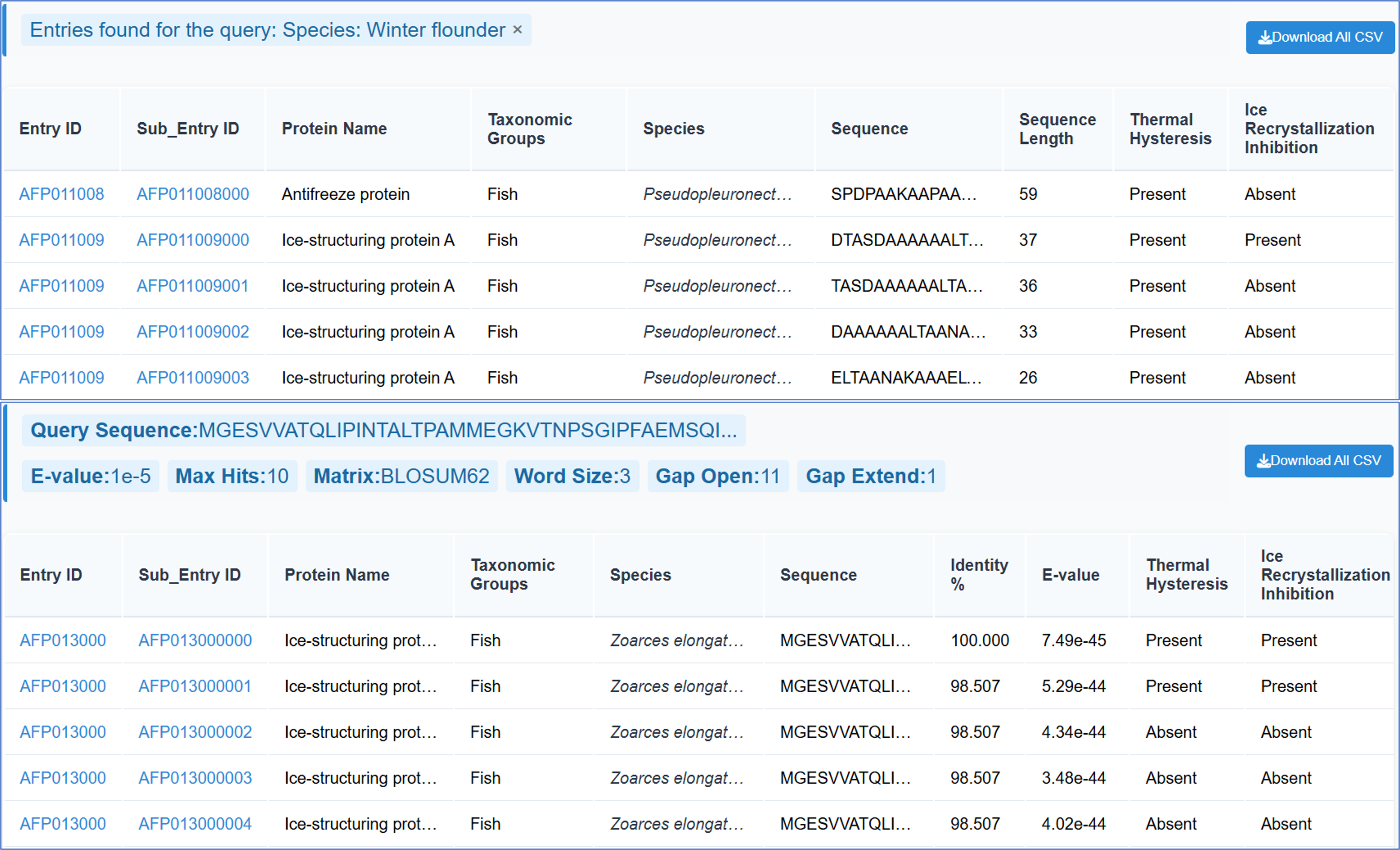
The search module can be accessed on the home page. Users can search the database “by Keywords” or “by protein sequence”. The former options include “UniProt ID”, “Species”, “Protein_Name”, “Pubmed_ID” and “DOI”. The latter utilizes BLASTP to search for records of similar sequences in the database, which allows user advanced search through resetting parameters including “E-value”, “Max hits”, “matrix”, “word size”, “gap open” and “gap extend”.
Irrespective of searching the database “by Keywords” or “by protein sequence”, a simplified table is displayed as results (as shown in Figure 1). The first two columns present the searched Entry ID and Sub_Entry ID, from which the associated detailed pages can be accessed by linkages. Protein Name, Taxonomic Groups, Species, Sequence, whether possess “Thermal Hysteresis” and “Ice Recrystallization Inhibition” data (“Present/Absent” means the data are available/absent in the record), as well as Sequence length (for “by Keywords”) or Identity and E-value (for “by protein sequence”) are also presented in the simplified table. Detail information of the queried data is available for download in CSV format.
Browse
The browse interface consists of a categorical navigation bar on the left and a tabular area on the right. Two primary classification categories include Taxonomic Groups (encompassing Fish, Insect, Plant, Bacteria, Diatom, Fungi and Others) and Antifreeze Assay (including Thermal Hysteresis Activity, Ice Recrystallization Inhibition Activity, Biological Cryoptotection Assessment, Ice Crystal Morphology, Ice Grow Rate, Fluresence-based Ice Plane Affinity, Ice Hemisphere Etching, Ice Pitting and Ice Nucleation). The table on the right displays content similar to that retrieved via the Search module. Detail pages can be accessed via links associated with Entry ID or Sub_Entry ID
The left-hand menu on each AFP detail page provides navigation to general entry information and subentry information, as well as the button for downloading the whole page content. Each entry records a unique naturally occurring AFP from a specific source organism. The general information of the entry presenting on the right-hand of the page primarily include protein name, UniProt ID, protein sequence as well as 3D structure visualization from PDB, Alphafold DB or Alphafold2 prediction. The solvent-accessible surface area (SASA) of the antifreeze protein based on the 3D structure is also presented on this page using the bioinformatics tool FreeSASA. Additional information, particularly data related to antifreeze activity experiments, is presented in subsequent subentries. Each subentry records the annotations of the raw antifreeze assay data in the corresponding publication, including thermal hysteresis activity, ice recrystallization inhibition activity,ice crystal morphology etc. (as shown in Figure 2), for either the wild type AFP (listed as the first subentry) or its specific variant with a unique sequence.
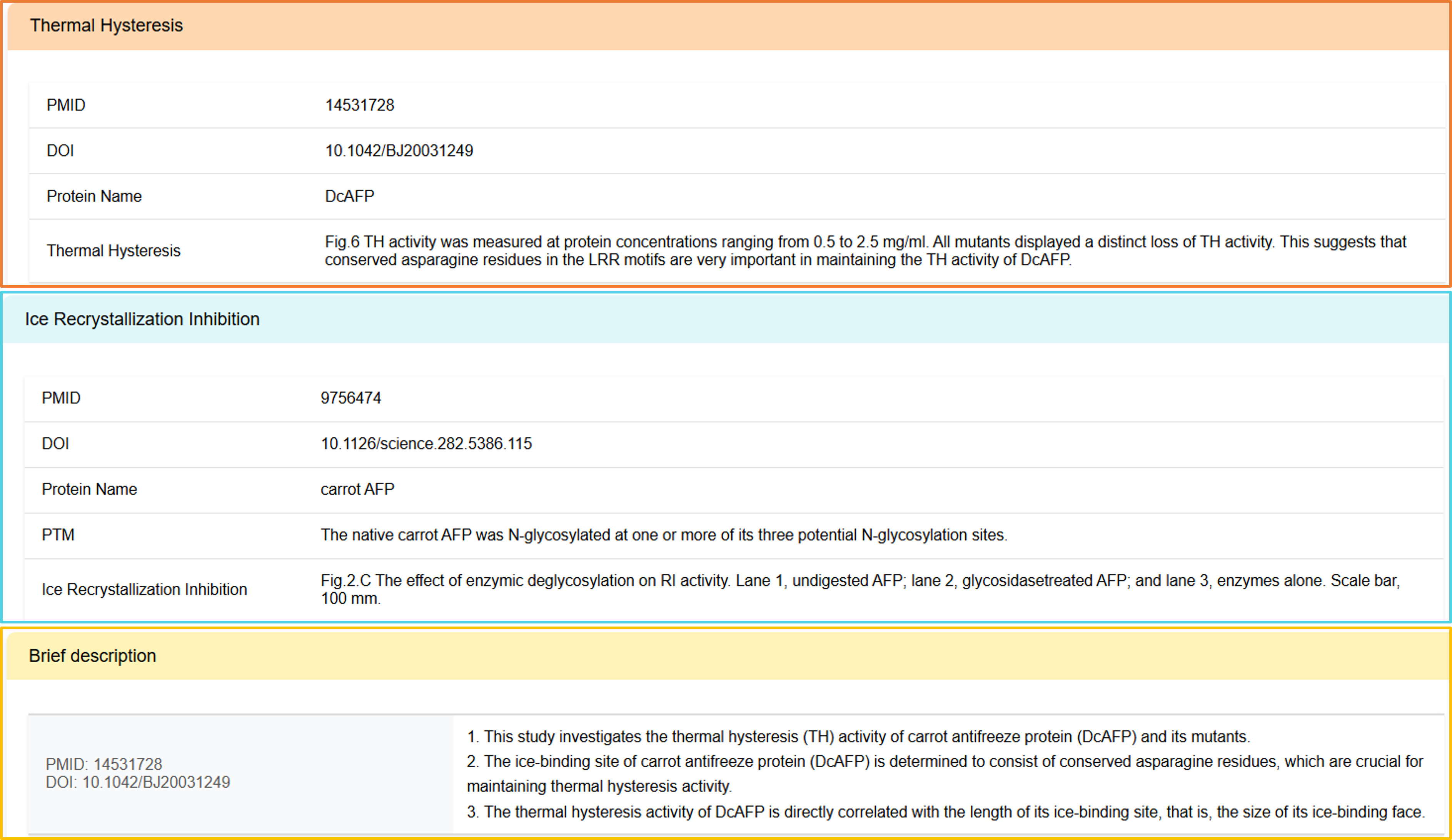
For the detailed information in subentries, two points should be noted that: Firstly, as some proteins have been investigated in different labs, more than one records of the same type of antifreeze assay appear in one subentry in some cases (such as several records of thermal hysteresis in one subentry). Therefore, the corresponding PMID/DOI and other annotations are presented in each assay record from one specific publication. Secondly, some raw figures/tables show measured data for more than one AFP (such as wild type and variants), then their corresponding annotations repeatedly emerge in multiple subentries. Additional important contents within antifreeze assay records are annotated as follows.
Mutation: It includes amino acid substitutions, insertions, deletions or inversion along sequence. The following formats are used:
Substitution format: original residue + sequence number + mutated residue. For example, “A20P” denotes the alanine (sequence number 20) is mutated to proline.
Insertion format: sequence number_sequence number + “ins” + inserted residues. For example, “94_95insGGYQGG” denotes peptide “GGYQGG” is inserteds between sequence number 94 and 95.
Deletion format: sequence number_sequence number + “del”. For example, “29_59del” denotes residue between sequence number 29 and 59 are deleted.
Inversion format: sequence number_sequence number + "inv". For example, "1_1290inv" denotes that the sequence from number 1 to number 1290 is inverted.
PTM: Post-translational modification reported in the literature.
Fusion: The expressed protein is a fusion protein.
Tag: Specified type of affinity tag (e.g., GST).
Ice-Binding Site: The region or specific residues of an AFP interact(s) directly with ice crystals. This field includes: (1) Identified key residues involved in ice binding (e.g., threonine-rich motifs). (2) Structural features such as β-sheets, motifs, or hydrophobic patches contributing to binding ice.
Ice Plane: The specific crystallographic planes of ice bound by an AFP. It is presented either as a summary statement of the result (e.g., “AKE binds to the prism plane of ice crystals, with ice-binding sites spaced at 7.1-7.5 Å, matching the ice lattice spacing.”) or as a direct quotation from the original literature.
Brief Description: At the end of each subentry record, the experimental results and discussion for a given AFP from each curated literature is summarized respectively, with the assistance of artificial intelligence tools GPT-4o and Beijing-YunQue-20230821 under expert supervision.
AFP-Predictor
Trained on protein sequences screened from AFP-DB and UniProt, AFP-Predictor is an AFP classifier constructed using ESM2 embeddings combined with a multilayer perceptron (MLP) model. The tool takes one single protein sequence each time as input and returns a corresponding prediction score.